Panier
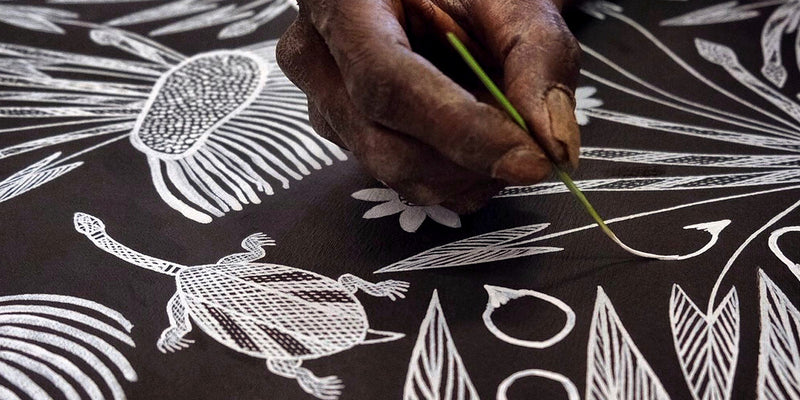
  • Tina Napangardi Martin, Jintiparnta Jukurrpa (Desert Truffle Dreaming) - Mina Mina, 107x46cm
  • Tina Napangardi Martin, Jintiparnta Jukurrpa (Desert Truffle Dreaming) - Mina Mina, 107x46cm
  • Tina Napangardi Martin, Jintiparnta Jukurrpa (Desert Truffle Dreaming) - Mina Mina, 107x46cm
  • Tina Napangardi Martin, Jintiparnta Jukurrpa (Desert Truffle Dreaming) - Mina Mina, 107x46cm

Tina Napangardi Martin, Jintiparnta Jukurrpa (Desert Truffle Dreaming) - Mina Mina, 107x46cm

..circles and roundels represent the ‘jintiparnta’ (desert truffle) that the women collected as they travelled..
  • Retours sous 120 jours
  • Envoi assuré gratuit
  • Expédié de Tasmanie sous 1 jour, transit 5 à 10 jours
  • TVA réduite à l'import sur l'art original
  • Images aux couleurs fidèles
Warlukurlangu Artists Certificate of Authenticity

Œuvre certifiée par la communauté

Cette œuvre originale est vendue au nom de Warlukurlangu Artists, un centre d’art communautaire. Elle comprend un certificat d’authenticité.

  • Aboriginal Artist - Tina Napangardi Martin
  • Community - Nyirripi  
  • Aboriginal Art Centre - Warlukurlangu Artists Aboriginal Corporation  
  • Catalogue number - 2206/26
  • Materials - Professiona artist acrylic on Belgian Linen
  • Size(cm) - H107 W46 D2  
  • Postage variants - Artwork posted un-stretched and rolled for safe shipping
  • Orientation - Painted from all sides and OK to hang as wished

This ‘jintiparnta Jukurrpa’ (desert truffle [Elderia arenivaga] Dreaming) comes from Mina Mina. Mina Mina is an extremely important ceremonial site for Napangardi and Napanangka women that is located approximately 600kms west of Yuendumu, just east of Lake Mackay and the WA border. The area has a ‘marluri’ (salt lake or claypan) that is usually dry, without water. There are also a number of ‘mulju’ (soakages), sandhills, and a large stand of ‘kurrkara’ (desert oaks [Allocasuarina decaisneana]). The Mina Mina Jukurrpa is an important source of Warlpiri ritual knowledge and social organization, particularly relating to the different roles performed by men and women.

The ‘kirda’ (owners) of this Jukurrpa are Napangardi/Napanangka women and Japangardi/Japanangka men. There are a number of different Jukurrpa associated with Mina Mina; artists usually choose to depict one particular Jukurrpa in their paintings. In addition to ‘jintiparnta’ (desert truffle), these can include ‘karnta’ (women), ‘karlangu’ (digging sticks), ‘majardi’ (hairstring skirts/tassels), ‘ngalyipi’ (snakevine [Tinospora smilacina]), and ‘kurrkara’ (desert oak [Allocasuarina decaisneana]).

The Mina Mina Jukurrpa tells the story of a group of ancestral ‘karnta’ (women) who traveled from west to east. In the Dreamtime, these ancestral women danced at Mina Mina and ‘karlangu’ (digging sticks) rose up out of the ground. They collected these digging sticks and started travelling to the east. They carried their digging sticks over their shoulders and they were adorned with ‘majardi’ (hairstring belts), white feathers, and necklaces made from ‘yinirnti’ (bean tree [Erythrina vespertilio]) seeds. They continuously anointed themselves with ‘minyira’ (shiny fat) to increase their ritual powers as they went along. As the women travelled, they were followed by a ‘yinkardakurdaku’ (spotted nightjar [Eurostopodus argus]) from the Jakamarra subsection. The bird would call out and then hide in the bushes behind them as they travelled.

When the women danced at Mina Mina, they created a large dust cloud that swept up the ‘walyankarna’ (snake ancestors). The ‘walyankarna’ had previously transformed themselves from witchetty grubs into snakes at Kunajarrayi (Mount Nicker, 200km southwest of Yuendumu), and they had stopped at Mina Mina to watch the women dance. This dust cloud blew the ‘walyankarna’ further north to Yaturluyaturlu (near the Granites gold mine). In this way, the ‘karnta Jukurrpa’ (women’s Dreaming) and ‘ngarlkirdi Jukurrpa’ (witchetty grub Dreaming) intersect. This allowed the ancestral women to observe the witchetty grubs and learn how to best locate and cook them, which are skills that Warlpiri women still use today.

The women went east from Mina Mina, dancing, digging for bush tucker, and creating many places as they went. As they went east, they passed through Kimayi (a stand of ‘kurrkara’ (desert oak)). They passed through sandhill country where the ‘yarla’ (bush potato or ‘big yam’ [Ipomea costata]) ancestors from Yumurrpa and the ‘ngarlajiyi’ (pencil yam or ‘small yam’ [Vigna lanceolata]) ancestors from Yumurrpa were engaged in a huge battle over women. This battle is also a very important Warlpiri Jukurrpa narrative. The women went on to Janyinki and stopped at Wakakurrku (Mala Bore), where they stuck their digging sticks in the ground. These digging sticks turned into mulga trees, which still grow at Wakakurrku today. The women then went on to Lungkardajarra (Rich Bore), where they looked back towards their country in the west and started to feel homesick for what they’d left behind.

The women split up at Lungkardajarra. Some of them travelled eastwards to Yarungkanyi (Mount Doreen), and kept going east. They passed through Coniston in Anmatyerre country, and then went on to Alcoota and Aileron and beyond. The other group of women travelled travelled northwards from Lungkardajarra to Karntakurlangu. These women stopped at Karntakurlangu (an area that literally means ‘belonging to women’) to dig for ‘wardapi’ (sand monitor/goanna [Varanus gouldii]) and ‘jintiparnta’ (desert truffle). ‘Jintiparnta’ appears in the sandhills after the winter rains. The growing fungus forces the earth above it to crack, exposing it. Women dig it out of the ground and squeeze out the liquid inside to drink before cooking it in hot ashes.

After stopping to collect the ‘jintiparnta’ at Karntakurlangu, the women kept traveling further north. However, both groups of women eventually got so homesick for their desert oak country in the west that they went all the way back to Mina Mina, where they stayed for good.

The Mina Mina Jukurrpa (of which this ‘jintiparnta’ Jukurrpa is a part) contains important information about the different roles that men and women play in Warlpiri culture, particularly in the context of ritual performance. It alludes to an earlier time in which their ritual and social roles were reversed, in which women controlled the sacred objects and weapons that are now exclusively “owned” by men.

In contemporary Warlpiri paintings, traditional iconography can be used to represent the Jukurrpa, particular sites, and other elements. In paintings of the ‘jintiparnta’ Jukurrpa, circles and roundels represent the ‘jintiparnta’ (desert truffle) that the women collected as they travelled, and straight lines represent their ‘karlangu’ (digging sticks).

Tina Napangardi Martin Robertson was born in 1960 in Yuendumu, a remote Aboriginal community 290 km north-west of Alice Springs in the NT of Australia. Her parents and grandparents are deceased and she has only one sister who lives in Laramba community, near Napperby Station. Tina went to the local school in Yuendumu. She lived there for most of her life but now lives in Nyirripi after she married her second husband, Douglas Wilson. They have one son born in 1997. She also has five grown-up children from her first marriage. Tina has been painting with Warlukurlangu Artisits Aboriginal Corporation, an Aboriginal owned and governed art centre located in Yuendumu, since 1996. When Warlukurlangu Artists began exploring print making in 1997, Tina began screen printing and batik. However it wasn’t until 2007, when the children were grownup, that Tina found the time to paint on a regular basis. She paints her father’s Jukurrpa stories which include Yurrampi Jukurrpa (Honey Ant Dreaming) and Janyinki Jukurrpa (Yanyinki Dreaming). She also paints Ngalyipi Jukurrpa (Snake Vine Dreaming) and recently Pulundari Jukurrpa (Mushroom Dreaming). Tina enjoys painting, especially when her children and grandchildren are watching. She loves to explain to them the meaning of the different designs and patterns. She also enjoys going hunting on weekends for bush tomato and bush sultanas and when she can she visits her father’s country and her country.

Art warlpiri du désert de Tanami

Art warlpiri du désert de Tanami

Cette œuvre provient de Warlukurlangu Artists à Yuendumu. Le centre d’art représente des artistes warlpiri de Yuendumu et Nyirripi, situés dans le désert de Tanami au nord-ouest d’Alice Springs. Cette région isolée de sable rouge et de vastes paysages désertiques est au cœur des récits et des savoirs transmis à travers les peintures.

— Image : communauté de Nyirripi, Territoire du Nord

"Great experience. Love my painting." - Caitlin, Aus – ART ARK Customer Review


← Page précédente Tissage de la Terre d'Arnhem Art de la Terre d'Arnhem Peintures aborigènes à points Abonnés Peintures tendues Tissage du désert Peintures de paysages


Remote Aboriginal artists share their culture through art

Soutien aux artistes aborigènes

En partageant leur culture, les artistes des régions éloignées créent des opportunités pour eux-mêmes. Acheter de l'art aborigène de manière éthique soutient ces artistes tout en apportant chaleur et sens à votre intérieur.


Aboriginal artwork displayed in a home

Des œuvres d'art originales qui embelliront votre intérieur

De belles œuvres d'art originales qui s'intègrent parfaitement à votre intérieur. Votre achat soutient les artistes aborigènes et nous aide à poursuivre notre mission de célébration et de promotion de l'art aborigène éthique.

Nous sommes convaincus que vous aimerez votre œuvre d'art, mais si, pour une raison quelconque, elle ne vous convient pas, retournez-la dans les 120 jours. Facile. Plus de 1 670 clients ont partagé leurs expériences, et ils adorent leurs œuvres d'art.

Réserver une œuvre

Vous pouvez sécuriser une œuvre avec un acompte de 20 %. Utilisez le code DEPOSIT20 lors du paiement et réglez le solde dans les 30 jours (nous vous enverrons une facture par e-mail).

Les acomptes ne sont pas remboursables, mais une fois le paiement intégral effectué, votre œuvre est expédiée normalement, couverte par notre politique de retour de 120 jours.


Aboriginal painting in situ with the certificate of authenticity shown

Authenticité certifiée par les centres d'art communautaires

Seuls les certificats des centres d'art aborigènes communautaires garantissent un approvisionnement éthique, assurant que votre achat soutient l'artiste et sa communauté. Chaque œuvre ART ARK® inclut cette documentation, offrant transparence et confiance quant à son origine. La preuve de provenance garantit l'authenticité et contribue à la valeur à long terme de l'œuvre.

En savoir plus sur l'authenticité de l'art aborigène.


Aboriginal artwork being photographed and colour corrected

Précision des couleurs garantie

Nous passons des heures pour garantir que votre œuvre d'art arrivera telle que présentée. Soigneusement emballée, aux couleurs exactes, et prête à être aimée.

Les couleurs sont assorties aussi fidèlement que possible, et avec moins de 0,2 % de retours, nos clients sont constamment ravis de leurs œuvres d'art.


Example of an Aboriginal painting framed in a float frame

Encadrer l'art aborigène

Nous maintenons une transparence des prix en livrant les œuvres sans frais tiers supplémentaires, ce qui nous permet d'offrir la livraison gratuite et de maintenir les prix en accord avec chaque centre d'art. Les toiles et les pièces en lin sont envoyées roulées pour une livraison sûre et un ré-étirage facile chez votre encadreur local.

En savoir plus sur l'encadrement de l'art aborigène.


Worldwide shipping from ART ARK

Expédition rapide et gratuite

De la Tasmanie à votre porte, où que vous soyez dans le monde. Les commandes sont expédiées sous 1 jour ouvrable et arrivent en 1 à 3 jours en Australie et en 5 à 10 jours à l'international. Profitez de la livraison domestique gratuite sur toutes les commandes. La livraison internationale est gratuite pour les commandes de plus de 500 $AUD, et un tarif fixe de 30 $AUD s'applique pour les commandes inférieures à ce montant.

Douanes et droits : Les œuvres d'art originales (codes tarifaires 9701.91 pour les peintures et dessins, 9703.00 pour les sculptures) sont exemptes de droits et taxes à l'arrivée aux États-Unis et au Canada. Le Royaume-Uni applique une TVA réduite de 5 %, la France 5,5 % et l'Allemagne 7 %. D'autres pays peuvent avoir des taux différents, nous vous recommandons donc de vérifier avant l'achat.

*Le délai de livraison estimé pour les expéditions internationales est de 5 à 10 jours ouvrables, sans compter le temps de traitement douanier, qui varie selon les pays.

En savoir plus sur les douanes et l'expédition.


arty emails? (they're good)