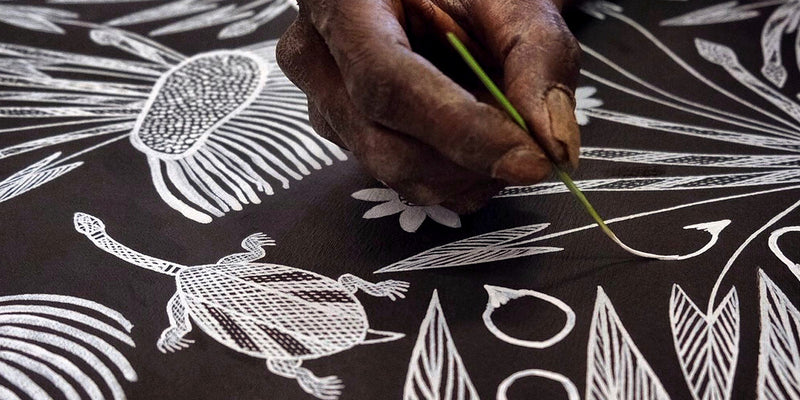
Paul Nabulumo Namarinjmak, Wak Wak, 122x39cm
Originales Kunstwerk, zertifiziert durch das gemeinschaftliche Kunstzentrum.
Gemeinschaftlich zertifiziertes Kunstwerk
Dieses originale Kunstwerk wird im Namen von Maningrida Arts and Culture, einem gemeinschaftlich geführten Kunstzentrum, verkauft. Es enthält ein Echtheitszertifikat.
– Unikat 1/1
- Details
- Artwork
- Artist
- Art Centre
- Aboriginal Artist - Paul Nabulumo Namarinjmak
- Community - Maningrida
- Homeland - Yikarrakkal Kubumi
- Aboriginal Art Centre - Maningrdia Arts
- Catalogue number - 461-24
- Materials - Earth pigments on fire-hardened stringybark
- Size(cm) - H122 W39 D1 (irregular)
- Orientation - As displayed
- Postage variant - Delivered ready to hang with a metal mount on the reverse
This painting depicts a sacred site at 'Kurrurldul', an outstation south of Maningrida. The 'rarrk', or abstract crosshatching, on this work represents the design for the crow totem ancestor called 'Djimarr'. Today this being exists in the form of a rock, which is permanently submerged at the bottom of Kurrurldul Creek. The 'Djimarr' rock in the stream at Kurrurldul is said to move around and call out in a soft hooting tone at night. Both the stone itself and the area around it are considered sacred. The imagery represents the rock mentioned above at the bottom of Kurrurldul creek, which is the final transmutation of the dreaming ancestor 'Djimarr'. Finally, the pattern used here is also the crow design used in the sacred 'Mardayin' ceremony, which is a large regional patri-moiety ceremony now rarely conducted in central and eastern Arnhem Land.
Details are currently unavailable
An art movement that is striking, political and enduring: this is what contemporary artists in Maningrida and the surrounding homelands have built, powered by their ancestral connections to country and djang.
Ways of learning and schools of art in Arnhem Land are based around a system of passing knowledge and information on to others. The art here has its genesis in body design, rock art and cultural practices, in concert with more than 50 years of collaborations, travel and political action to retain ownership of country. Values and law are expressed through language, imagery, manikay (song), bunggul (dance), doloppo bim (bark painting), sculptures, and kun-madj (weaving) – the arts.
The artists’ transformation of djang into contemporary artistic expression has intrigued people around the world: art curators and collectors, and stars including Yoko Ono, Jane Campion, David Attenborough and Elton John. Pablo Picasso said of Yirawala’s paintings, ‘This is what I’ve been trying to achieve all my life.’
Yirawala (c.1897–1976) was a legendary Kuninjku leader, artist, land-rights activist and teacher, and his artwork was the first of any Indigenous artist to be collected by the National Gallery of Australia as part of a policy to represent in depth the most significant figures in Australian art.
Maningrida Arts & Culture is based on Kunibídji country in Arnhem Land in Australia’s Northern Territory. The area where artists live encompasses 7,000 square kilometres of land and sea, and over 100 clan estates, where people speak more than 12 distinct languages. Aboriginal people in this region are still on country, surviving and resilient because their country is the centre of their epistemology, their belief system, culture – djang.
Artists’ works from the larger Maningrida region can be seen in collections and institutions around the world. We work with museums, contemporary galleries and high-end retailers both nationally and internationally on projects throughout the year.
Text courtesy: Maningrida Arts and Culture
"The art is beautiful and has brightened our home." - Barbara, Aus – ART ARK Customer Review
Kunst aus Arnhem Land aus den Homelands von Maningrida
Dieses Kunstwerk stammt von Maningrida Arts & Culture im Kunibídji-Land in Arnhem Land. Künstler leben in Homelands, die mehr als 7.000 km² Land und Meer sowie über 100 Clan-Gebiete umfassen, in denen viele unterschiedliche Sprachen gesprochen werden und Menschen weiterhin auf ihrem Country leben.
— Bild: Freda Ali Wayartja beim Sammeln von Pandanus, Maningrida Arts & Culture