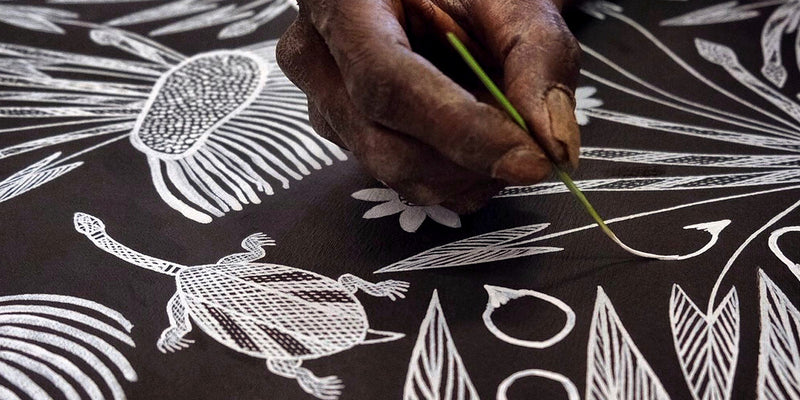
Mina Mina est un site cérémoniel extrêmement important pour les femmes Napangardi et Napanangka, situé à environ 600 km à l'ouest de Yuendumu, juste à l'est du lac Mackay et de la frontière avec l'Australie-Occidentale. La zone possède un « marluri » (lac salé ou dépression argileuse) qui est généralement sec, sans eau. On y trouve également un certain nombre de « mulju » (points d'eau), des dunes de sable et un grand peuplement de « kurrkara » (chênes du désert [Allocasuarina decaisneana]). Le Jukurrpa de Mina Mina est une source importante de connaissances rituelles et d'organisation sociale Warlpiri, particulièrement en ce qui concerne les différents rôles joués par les hommes et les femmes.
Les « kirda » (propriétaires) de ce pays sont les femmes Napangardi/Napanangka et les hommes Japangardi/Japanangka, qui peuvent représenter des parties du Jukurrpa de Mina Mina dans leurs peintures. Le Jukurrpa de Mina Mina se compose de plusieurs éléments ; les artistes choisissent généralement de représenter un aspect particulier. Ceux-ci peuvent inclure des « karnta » (femmes), des « karlangu » (bâtons à fouir), des « majardi » (jupes/glands en cheveux humains), du « ngalyipi » (liane serpent [Tinospora smilacina]), de la « jintiparnta » (truffe du désert [Elderia arenivaga]) et du « kurrkara » (chêne du désert [Allocasuarina decaisneana]).
Le Jukurrpa de Mina Mina raconte l'histoire d'un groupe d'ancêtres « karnta » (femmes) qui ont voyagé d'ouest en est. Au temps du Rêve, ces ancêtres féminins ont dansé à Mina Mina et des « karlangu » (bâtons à fouir) ont surgi du sol. Elles ont ramassé ces bâtons et ont commencé à voyager vers l'est. Elles portaient leurs bâtons sur leurs épaules et étaient parées de « majardi » (ceintures en cheveux humains), de plumes blanches et de colliers faits de graines de « yinirnti » (arbre à haricots [Erythrina vespertilio]). Elles s'oignaient continuellement de « minyira » (graisse brillante) pour accroître leurs pouvoirs rituels au fur et à mesure de leur périple. Tandis que les femmes voyageaient, elles étaient suivies par un « yinkardakurdaku » (engoulevent à points [Eurostopodus argus]) de la sous-section Jakamarra. L'oiseau poussait un cri puis se cachait dans les buissons derrière elles pendant qu'elles avançaient.
Lorsque les femmes dansaient à Mina Mina, elles créaient un immense nuage de poussière qui balayait les ancêtres « walyankarna » (serpents). Les « walyankarna » s'étaient précédemment transformés de larves de witchetty en serpents à Kunajarrayi (mont Nicker, à 200 km au sud-ouest de Yuendumu), et ils s'étaient arrêtés à Mina Mina pour regarder les femmes danser. Ce nuage de poussière a poussé les « walyankarna » plus au nord jusqu'à Yaturluyaturlu (près de la mine d'or des Granites). De cette façon, le « karnta Jukurrpa » (Rêve des femmes) et le « ngarlkirdi Jukurrpa » (Rêve des larves de witchetty) s'entrecroisent. Cela a permis aux femmes ancestrales d'observer les larves de witchetty et d'apprendre comment les localiser et les cuisiner au mieux, des compétences que les femmes Warlpiri utilisent encore aujourd'hui.
Les femmes sont allées à l'est depuis Mina Mina, dansant, creusant à la recherche de nourriture de brousse et créant de nombreux lieux sur leur passage. En se dirigeant vers l'est, elles ont traversé Kimayi (un peuplement de « kurrkara » (chênes du désert)). Elles ont traversé un pays de dunes de sable où les ancêtres « yarla » (patate de brousse ou « grosse igname » [Ipomea costata]) de Yumurrpa et les ancêtres « ngarlajiyi » (igname crayon ou « petite igname » [Vigna lanceolata]) de Yumurrpa étaient engagés dans une bataille acharnée pour des femmes. Cette bataille est également un récit très important du Jukurrpa Warlpiri. Les femmes ont continué jusqu'à Janyinki et se sont arrêtées à Wakakurrku (Mala Bore), où elles ont planté leurs bâtons à fouir dans le sol. Ces bâtons se sont transformés en arbres mulga, qui poussent encore aujourd'hui à Wakakurrku. Les femmes ont ensuite poursuivi jusqu'à Lungkardajarra (Rich Bore), où elles ont regardé en arrière vers leur pays à l'ouest et ont commencé à ressentir le mal du pays pour ce qu'elles avaient laissé derrière elles.
Les femmes se sont séparées à Lungkardajarra. Certaines ont voyagé vers l'est jusqu'à Yarungkanyi (mont Doreen) et ont continué vers l'est. Elles ont traversé Coniston dans le pays Anmatyerre, puis sont allées à Alcoota, Aileron et au-delà. L'autre groupe de femmes a voyagé vers le nord depuis Lungkardajarra jusqu'à Karntakurlangu. Ces femmes se sont arrêtées à Karntakurlangu pour creuser à la recherche de « wardapi » (varan de Gould [Varanus gouldii]) et de « jintiparnta » (truffe du désert) avant de continuer vers le nord. Les deux groupes ont fini par ressentir un tel mal du pays pour leur contrée de chênes du désert à l'ouest qu'ils sont retournés jusqu'à Mina Mina, où ils sont restés pour de bon.
Ce Jukurrpa contient des informations importantes sur les différents rôles que les hommes et les femmes jouent dans la culture Warlpiri, en particulier dans le contexte de la pratique rituelle. Il fait allusion à une époque plus ancienne où leurs rôles rituels et sociaux étaient inversés, une époque où les femmes contrôlaient les objets sacrés et les armes qui sont aujourd'hui exclusivement « possédés » par les hommes.
Dans les peintures Warlpiri contemporaines, l'iconographie traditionnelle peut être utilisée pour représenter le Jukurrpa, des sites particuliers et d'autres éléments. Dans les peintures du Jukurrpa de Mina Mina, des lignes sinueuses sont souvent utilisées pour représenter le « ngalyipi » (liane serpent). Les cercles et les rosaces peuvent représenter la « jintiparnta » (truffe du désert) que les femmes ramassaient au cours de leur voyage, et les lignes droites sont utilisées pour représenter les « karlangu » (bâtons à fouir). Les « majardi » (jupes en cheveux humains) sont représentés par des lignes ondulées suspendues à une ligne courbe unique.