Panier
  • Matilda Pascoe and Jeremiah Bonson, Warraburnburn Family (4), 142cm
  • Matilda Pascoe and Jeremiah Bonson, Warraburnburn Family (4), 142cm
  • Matilda Pascoe and Jeremiah Bonson, Warraburnburn Family (4), 142cm
Matilda Pascoe and Jeremiah Bonson, Warraburnburn Family (4), 142cm

Matilda Pascoe and Jeremiah Bonson, Warraburnburn Family (4), 142cm

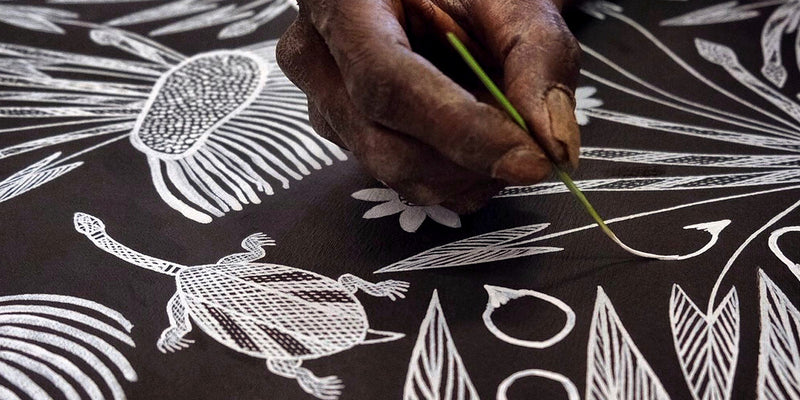
Warraburnburn ghost spirits, marked with white dots, represents spirit beings who move together across Warrawarra Country.
$3,079.00 1670+ Reviews

Œuvre originale certifiée par le centre d’art communautaire.

Livraison assurée gratuite et retours sous 120 jours
Expédié depuis l’Australie sous 24 heures ouvrables
Livraison rapide dans le monde entier*
Précision des couleurs garantie
Maningrida Arts and Culture – Certificat d’authenticité

Œuvre certifiée par la communauté

Cette œuvre originale est vendue au nom de Maningrida Arts and Culture, un centre d’art communautaire. Elle comprend un certificat d’authenticité.

  • Aboriginal Artists - Matilda Pascoe, Jeremiah Bonson
  • Community - Gamurra Gu-yurra
  • Homeland - 
  • Aboriginal Art Centre - Maningrida Arts and Culture
  • Catalogue number - 1329-25, 1303-25, 1160-25, 1293-25
  • Materials - Cottonwood (Bombas Ceiba) with Ochre Pigment and PVA Fixative
  • Size(cm) - H142, H106, H76, H71
  • Display - Stand recommended

In Burarra and Gun-nartpa languages the figure represented in this artwork is generally known as a wangarra ‘ghost spirit’. For the Warrawarra clan ghost spirits have their own particular characteristics and their own name – Warraburnburn.

The Warraburnburn and the closely related Galabarrbarr spirit (owned by the Balkarranga clan) are also manikay song topics.  The spirits are related to each other as maternal grandparent and grandchild, just as the people of Warrawarra and Balkarranga are. The dancing of the two ghost spirit figures forms the finale performance for funerals, and is the final goodbye to a deceased family member.

In many ways the Warraburnburn and Galabarrbarr ghost spirits are like people. They emerge from the patches of jungle on Warrawarra and Balkarranga country in the late afternoon and go hunting in family groups of men, women and children. They stay in contact with each other by calling out as the men hunt for fish and the women walk with their dillybags looking for vegetable food. 

The ghost spirits are associated closely with white ochre and artists commonly paint the bodies of carved figures in white. Different types of ghost spirit wear different patterns. Warraburnburn is decorated with uniform white dots while others are painted white all over. Some ghost spirits are shown with a design painted on their chest infilled with rarrk ‘cross-hatching’, the same designs that are painted onto japi an-guyinda ‘male initiations’. 

They also have supernatural characteristics including superhuman size (jarra anbaykarda ‘super tall’). They know the country intimately – some are malevolent towards humans and will lead people astray, taking them to unfamiliar and dangerous places. These malevolent spirits are likened to an-muburda ‘sorcerers’ and can conduct dangerous rituals that cause harm to people. Others are benign and will lead humans back to familiar paths and their own camps.

Jeremiah Bonson is a Djinaŋ/Marung artist. He was born in Darwin but raised at the outstation Gamurra-Gu-yurra, his mother Matilda Pascoe’s country. Jeremiah and his wife lived in Galiwinku but moved to Maningrida in 2021 with their small family. Jeremiah is a dancer, musician (he plays the yidaki or didgeridoo), painter and sculptor. Although an emerging artist, he was taught his traditional culture and traditional song line (bourgur) by his adoptive father Jimmy. His practice is informed by a culture thousands of years old.

Matilda Pascoe is a sculptor and bark painter and member of the Warrawarra clan whose lands lie on Burarra country to the east of the Blyth River. She depicts spirit beings, plants and animals for which she is custodian (Traditional Owner), including Warraburnburn (‘ghost’sds spirit), baru (crocodile), jarlambu (catfish), gorraporda  (cormorant) and banaka (digging stick). She is most renowned for her bold, large-scale, warraburburn carvings, a ‘supertall’ jarra an-baykarda ‘ghost’ figure that lives in patches of jungle surrounding her homeland Gamurra Gu-yurra. She learned under the guidance of her late husband Jimmy An-gunguna, an important bark painter and sculptor whose works were included in Metamorphosis at the Venice Biennale in 1997. 

An art movement that is striking, political and enduring: this is what contemporary artists in Maningrida and the surrounding homelands have built, powered by their ancestral connections to country and djang.

Ways of learning and schools of art in Arnhem Land are based around a system of passing knowledge and information on to others. The art here has its genesis in body design, rock art and cultural practices, in concert with more than 50 years of collaborations, travel and political action to retain ownership of country. Values and law are expressed through language, imagery, manikay (song), bunggul (dance), doloppo bim (bark painting), sculptures, and kun-madj (weaving) – the arts.

The artists’ transformation of djang into contemporary artistic expression has intrigued people around the world: art curators and collectors, and stars including Yoko Ono, Jane Campion, David Attenborough and Elton John. Pablo Picasso said of Yirawala’s paintings, ‘This is what I’ve been trying to achieve all my life.’

Yirawala (c.1897–1976) was a legendary Kuninjku leader, artist, land-rights activist and teacher, and his artwork was the first of any Indigenous artist to be collected by the National Gallery of Australia as part of a policy to represent in depth the most significant figures in Australian art.

Maningrida Arts & Culture is based on Kunibídji country in Arnhem Land in Australia’s Northern Territory. The area where artists live encompasses 7,000 square kilometres of land and sea, and over 100 clan estates, where people speak more than 12 distinct languages. Aboriginal people in this region are still on country, surviving and resilient because their country is the centre of their epistemology, their belief system, culture – djang.

Artists’ works from the larger Maningrida region can be seen in collections and institutions around the world. We work with museums, contemporary galleries and high-end retailers both nationally and internationally on projects throughout the year.

Text courtesy: Maningrida Arts and Culture

"Quick delivery and friendly updates." - Rachel, NZ – ART ARK Customer Review

Art d’Arnhem Land des homelands de Maningrida

Art d’Arnhem Land des homelands de Maningrida

Cette œuvre provient de Maningrida Arts & Culture, basé sur le pays Kunibídji en Arnhem Land. Les artistes vivent dans des homelands couvrant plus de 7 000 km² de terre et de mer et plus de 100 domaines claniques, où de nombreuses langues distinctes sont parlées et où les communautés continuent de vivre sur leur Country.

— Image : Freda Ali Wayartja récoltant le pandanus, Maningrida Arts & Culture


← Page précédente Tissage d'Arnhem Land Art d'Arnhem Land Peintures à points Abonnés Peintures tendues Tissages du désert Peintures de paysages