Einkaufswagen
  • Maureen Ali, Coil Basket
  • Maureen Ali, Coil Basket
  • Maureen Ali, Coil Basket
  • Maureen Ali, Coil Basket

Maureen Ali, Coil Basket

Coil basketry is a well-established fibre art form in the Maningrida region..
  • 120 Tage Rückgaberecht
  • Kostenloser versicherter Versand
  • Versand aus Tasmanien in 1 Werktag, Transit 5 bis 10 Tage
  • Ermäßigte Einfuhrumsatzsteuer auf Originalkunst
  • Farbtreue Bilder
Maningrida Arts and Culture Certificate of Authenticity

Gemeinschaftlich zertifiziertes Kunstwerk

Dieses originale Kunstwerk wird im Namen von Maningrida Arts and Culture, einem gemeinschaftlich geführten Kunstzentrum, verkauft. Es enthält ein Echtheitszertifikat.

  • Aboriginal Artist - Maureen Ali
  • Community - Maningrida
  • Homeland - 
  • Aboriginal Art Centre - Maningrida Arts and Culture
  • Catalogue number - 102-26
  • Materials - Pandanus with natural dyes
  • Size(cm) - H34 L34 W34

Coil basketry is a well-established fibre art form in the Maningrida region, especially for women from the Kuninjku, Rembarrnga, Ndjebbana and Nakkara language groups. 

Artists make coiled baskets of many shapes and sizes, ranging from small round baskets to large oval baby baskets, and made mostly from pandanus fibre that is dyed with natural pigments. Bundles of fibre are formed into coils which are covered and stitched together with strands of fibre threaded onto a needle. Artists combine colours and patterns to obtain intricate new graphic patterns.

These techniques are believed to have been introduced to Arnhem Land by Greta Matthews, a missionary on Goulburn Island in the 1920s. She had probably learnt coil basketry from Aboriginal people in the south-east of Australia, possibly the Murray River people such as the Yorta Yorta or the coastal Ngarrindjeri. 

The coiling technique spread quickly from Goulburn Island to people on mainland Arnhem Land. 


Maureen Ali learned to weave under the guidance of her sister Bonny Burarn.garra, a highly skilled fibre artist who has exhibited in commercial galleries around Australia since the 1990s. She also learned from her watching her mother, leading fibre artist Lorna Jin-gubarrangunyja, who won the Wandjuk Marika Award at the 20th Telstra National Aboriginal and Torres Strait Islander Art Award (NATSIAA) in 2013 with a colourful pandanus fish trap.

Maureen has been practicing since 2006. She is Burarra, one of the east-side language groups who specialise in the customary conical dilly bags, woven string bags and mats. She is particularly renowned for the use of mirlarl, (malaisia scandens), a type of vine that grows in the coastal jungle. The use of this vine to manufacture fish traps, barriers and large strong dillybags is unique to this region. 

An art movement that is striking, political and enduring: this is what contemporary artists in Maningrida and the surrounding homelands have built, powered by their ancestral connections to country and djang.

Ways of learning and schools of art in Arnhem Land are based around a system of passing knowledge and information on to others. The art here has its genesis in body design, rock art and cultural practices, in concert with more than 50 years of collaborations, travel and political action to retain ownership of country. Values and law are expressed through language, imagery, manikay (song), bunggul (dance), doloppo bim (bark painting), sculptures, and kun-madj (weaving) – the arts.

The artists’ transformation of djang into contemporary artistic expression has intrigued people around the world: art curators and collectors, and stars including Yoko Ono, Jane Campion, David Attenborough and Elton John. Pablo Picasso said of Yirawala’s paintings, ‘This is what I’ve been trying to achieve all my life.’

Yirawala (c.1897–1976) was a legendary Kuninjku leader, artist, land-rights activist and teacher, and his artwork was the first of any Indigenous artist to be collected by the National Gallery of Australia as part of a policy to represent in depth the most significant figures in Australian art.

Maningrida Arts & Culture is based on Kunibídji country in Arnhem Land in Australia’s Northern Territory. The area where artists live encompasses 7,000 square kilometres of land and sea, and over 100 clan estates, where people speak more than 12 distinct languages. Aboriginal people in this region are still on country, surviving and resilient because their country is the centre of their epistemology, their belief system, culture – djang.

Artists’ works from the larger Maningrida region can be seen in collections and institutions around the world. We work with museums, contemporary galleries and high-end retailers both nationally and internationally on projects throughout the year.

Text courtesy: Maningrida Arts and Culture

Kunst aus Arnhem Land aus den Homelands von Maningrida

Kunst aus Arnhem Land aus den Homelands von Maningrida

Dieses Kunstwerk stammt von Maningrida Arts & Culture im Kunibídji-Land in Arnhem Land. Künstler leben in Homelands, die mehr als 7.000 km² Land und Meer sowie über 100 Clan-Gebiete umfassen, in denen viele unterschiedliche Sprachen gesprochen werden und Menschen weiterhin auf ihrem Country leben.

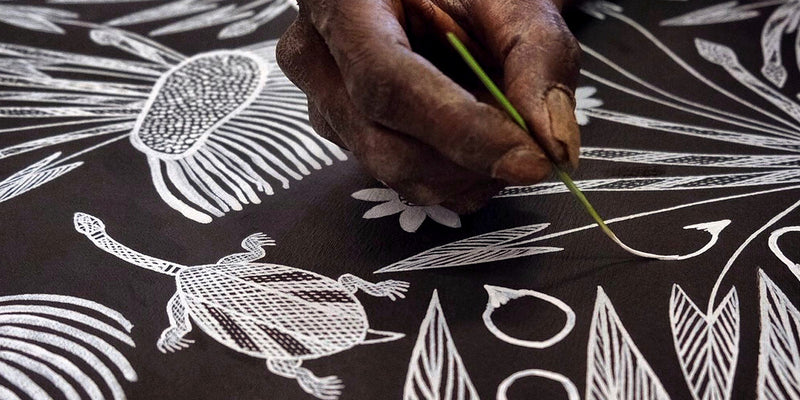
— Bild: Freda Ali Wayartja beim Sammeln von Pandanus, Maningrida Arts & Culture

"The personal story that came with the piece means I can pass this knowledge onto visitors who ask about the work. It really stands out on a white wall and makes me happy each time I look at it." - Rachel, Aus

– Read all 1,680+ ART ARK Customer Reviews

← Vorherige Seite Arnhem Land Webereien Kunst aus Arnhem Land Punktmalereien Abonnenten Gerahmte Gemälde Wüstenwebereien Landschaftsgemälde


Remote Aboriginal artists share their culture through art

Unterstützung der Aborigine-Künstler

Durch das Teilen ihrer Kultur schaffen abgelegene Künstler Möglichkeiten für sich selbst. Der ethische Kauf von Aborigine-Kunst unterstützt diese Künstler und bringt gleichzeitig Wärme und Bedeutung in Ihr Zuhause.


Aboriginal artwork displayed in a home

Originalkunst, die bei Ihnen großartig aussehen wird

Wunderschöne, originale Kunst, die perfekt in Ihr Zuhause passt. Ihr Kauf unterstützt Aborigine-Künstler und hilft uns, unsere Mission zur Feier und Förderung ethischer Aborigine-Kunst fortzusetzen.

Wir sind zuversichtlich, dass Sie Ihr Kunstwerk lieben werden, aber falls es aus irgendeinem Grund nicht passt, können Sie es innerhalb von 120 Tagen zurückgeben. Ganz einfach. Über 1.680 ehemalige Kunden haben ihre Erfahrungen geteilt, und sie lieben ihre Kunstwerke.

Reservierung eines Werkes

Sie können ein Werk gerne mit einer Anzahlung von 20 % sichern. Verwenden Sie den Code DEPOSIT20 an der Kasse und begleichen Sie den Restbetrag innerhalb von 30 Tagen (wir senden Ihnen eine Rechnung per E-Mail).

Anzahlungen sind nicht erstattungsfähig, aber sobald der volle Betrag bezahlt ist, wird Ihr Kunstwerk wie gewohnt versandt und ist durch unsere 120-Tage-Rückgabe abgedeckt.


Aboriginal painting in situ with the certificate of authenticity shown

Authentizität zertifiziert von Community Art Centern

Nur Zertifikate von gemeindebasierten Aborigine-Kunstzentren garantieren eine ethische Beschaffung und stellen sicher, dass Ihr Kauf den Künstler und seine Gemeinschaft unterstützt. Jedes ART ARK®-Stück enthält diese Dokumentation, die Transparenz und Vertrauen in seinen Ursprung bietet. Der Nachweis der Herkunft gewährleistet die Authentizität und trägt zum langfristigen Wert des Kunstwerks bei.

Erfahren Sie mehr über die Authentizität der Aborigine-Kunst.


Aboriginal artwork being photographed and colour corrected

Farbgenauigkeit garantiert

Wir verbringen Stunden damit, sicherzustellen, dass Ihr Kunstwerk wie abgebildet ankommt. Sorgfältig verpackt, farbgetreu und bereit, geliebt zu werden.

Die Farben werden so genau wie möglich angepasst, und mit einer Rücksendequote von unter 0,2 % sind unsere Kunden stets begeistert von ihren Kunstwerken.


Example of an Aboriginal painting framed in a float frame

Rahmung von Aborigine-Kunst

Wir halten die Preise transparent, indem wir Kunstwerke ohne zusätzliche Kosten von Drittanbietern liefern, was es uns ermöglicht, kostenlosen Versand anzubieten und die Preise in Übereinstimmung mit jedem Kunstzentrum zu halten. Leinwand- und Leinenstücke werden gerollt für den sicheren Versand und einfaches erneutes Aufspannen bei Ihrem lokalen Rahmenmacher versendet.

Erfahren Sie mehr über das Rahmen von Aborigine-Kunst.


Worldwide shipping from ART ARK

Schneller, kostenloser Versand

Von Tasmanien bis zu Ihrer Haustür, egal wo auf der Welt Sie sind. Bestellungen werden innerhalb von 1 Werktag versandt und kommen innerhalb von 1 bis 3 Tagen in Australien und 5 bis 10 Tagen international an. Genießen Sie kostenlosen Inlandsversand für alle Bestellungen. Der internationale Versand ist für Bestellungen über 500 A$ kostenlos, und für Bestellungen unter diesem Betrag wird eine Pauschale von 30 A$ erhoben.

Zölle & Abgaben: Originalkunstwerke (Tarifcodes 9701.91 für Gemälde und Zeichnungen, 9703.00 für Skulpturen) sind bei der Ankunft in den Vereinigten Staaten und Kanada zoll- und steuerfrei. Das Vereinigte Königreich wendet eine reduzierte Mehrwertsteuer von 5 % an, Frankreich 5,5 % und Deutschland 7 %. Andere Länder können unterschiedliche Sätze haben, daher empfehlen wir, dies vor dem Kauf zu überprüfen.

*Die geschätzte Lieferzeit für internationale Sendungen beträgt 5–10 Werktage, ohne etwaige Zollabwicklungszeiten, die je nach Land variieren.

Erfahren Sie mehr über Zoll und Versand.


arty emails? (they're good)